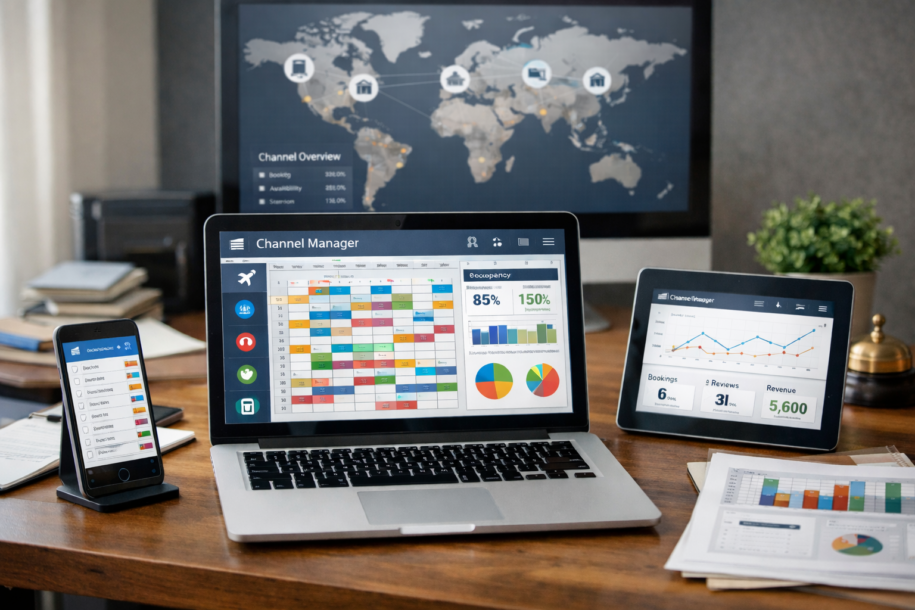
In the era of digital tourism, online visibility is the driving force behind every accommodation business. Hotels, B&Bs, and vacation rentals compete daily to attract bookings across dozens of channels: Booking, Expedia, Airbnb, Google Hotel, and direct portals. Managing all of this manually is unthinkable. This is where the channel manager comes into play—the software that automates and synchronizes room availability and rates in real time across all online channels.
Baggysitter is an innovative service that allows travelers to free themselves from the burden of luggage: a driver collects suitcases directly from the airport, train station, or any point in the city and delivers them to a hotel, B&B, private home, or any chosen address—and vice versa. This door-to-door service simplifies travel and makes the experience more convenient for both guests and accommodation providers. Like channel managers, Baggysitter optimizes time and streamlines processes, improving the experience for both travelers and hospitality operators.
INDEX
- What a channel manager is and what it is used for
- How a channel manager works
- Why it is essential for hotels and B&Bs
- Practical benefits for users
- The role of dynamic pricing in rate management
- The most widely used channel management software
- How to choose the right channel manager for your property
- Integration between channel manager and hotel management system
- Common configuration mistakes to avoid
- The importance of staff training
- Technology, automation, and revenue strategies
- The future of digital hotel distribution
1. What a channel manager is and what it is used for
A channel manager is software that allows centralized management of availability, rates, and reservations for an accommodation property across all online channels. In practice, when a guest books a room on a portal such as Booking, the system automatically updates availability on all other connected channels, preventing double bookings and ensuring a fully synchronized calendar.
Created as a response to the growing complexity of digital distribution, the channel manager is now an essential tool for hotels, B&Bs, vacation rentals, and property managers who want to save time, reduce errors, and optimize profitability.
A good channel manager not only updates availability, but also enables dynamic rate management, performance analysis across channels, and integration of revenue management strategies with major OTA portals and the property’s website.
2. How a channel manager works
A channel manager operates on a simple principle: connecting the property’s management system (PMS or hotel software) with online sales portals. Every time a guest books, cancels, or changes a reservation, the system updates all channels in real time and keeps availability consistent.
The channel manager connects via API or XML to dozens of OTAs and metasearch platforms. This continuous bidirectional data flow allows properties to automatically update prices and availability, centralize reservations in a single control panel, drastically reduce the risk of overbooking, and analyze the profitability of each channel.
Many channel managers also integrate with revenue management systems and marketing software, creating a complete digital ecosystem for hospitality management.
3. Why it is essential for hotels and B&Bs
Manually managing multiple booking portals is a time-consuming and resource-intensive task. Even a small error can be costly: a room sold twice, an outdated rate, or an incomplete calendar. The channel manager solves these issues by automating operations and updating data in real time.
For independent properties and B&Bs, often operating with limited resources, this means saving hours of work every day. For hotel chains, it enables centralized management of multiple properties with a clear overview of overall performance.
Beyond saving time, the biggest advantage is higher profitability. By optimizing online visibility and keeping rates consistently updated, a property can attract more guests and reduce periods of low occupancy.
4. Practical benefits for users
Adopting a channel manager brings several tangible benefits. Real-time synchronization prevents overbooking, avoids portal-to-portal discrepancies, and keeps availability and rates consistent everywhere. Greater online visibility puts your property in front of more travelers and increases the likelihood of bookings. With centralized management, you can control every reservation from a single dashboard, while price optimization lets you implement dynamic pricing and run last-minute offers with confidence.
By cutting manual tasks, you reduce operational workload and free up more time to focus on guest service. Analytics and reporting tools provide accurate data to support strategic decisions. For guests, all of this results in a smoother experience, with accurate information, reliable availability, and faster response times.
5. The role of dynamic pricing in rate management
One of the most important aspects of online distribution is dynamic rate management. Dynamic pricing adjusts room rates based on demand, seasonality, and guest behavior. Modern channel managers integrate intelligent algorithms that suggest automatic rate changes to maximize revenue.
For example, if demand increases during a specific period or due to local events, the system can raise prices in real time. Conversely, during low season, it can propose targeted discounts to stimulate bookings. This flexibility forms the foundation of revenue management, enabling properties to maximize returns on every available room.
6. The most widely used channel management software
The channel manager market is broad and highly competitive. You’ll find tools built for independent hotels, more scalable platforms designed for groups and chains, and “all-in-one” systems that combine a channel manager with a PMS and additional modules. Among the most widely known solutions are:
- Slope – an Italian management system that aims to unify channel manager, PMS, and CRM in one environment. This approach can make sense for teams that prefer fewer tools and more centralized data and workflows.
- SiteMinder – often chosen by mid-size to large properties and hotel groups managing high booking volumes and many distribution channels. It tends to be a strong fit when scalability, reliability, and a wide integration ecosystem are key.
- Vertical Booking – a well-established option in Italy, frequently valued for solid PMS integrations and structured distribution management. It can be a natural choice for hotels that already run standardized processes and want operational continuity.
- RoomCloud – known for a user-friendly setup and relatively fast onboarding. It’s typically well suited for B&Bs and small hotels that want to reduce manual updates and the risk of overbookings without adding unnecessary complexity.
- WuBook – often appreciated for its versatility and Italian-language technical support. It can be a good match for independent properties looking for flexibility and responsive assistance.
- Cloudbeds – an international platform that goes beyond channel management, potentially including revenue and marketing-related modules depending on configuration. It’s commonly considered when a property wants a broader, more integrated stack—especially for multi-property operations or advanced needs.
The choice of software depends on property size, budget, operational complexity, and the desired level of digitalization.
7. How to choose the right channel manager for your property
Choosing the right channel manager starts with a clear assessment of how your property operates today—and where you want to be in 6–12 months. The best solution isn’t necessarily the most famous one, but the one that matches your workflow and reduces daily friction.
Key criteria to evaluate include ease of use (how quickly your team can adopt it), compatibility with your PMS and booking engine, the reliability of connections (stable API links and real-time updates), the quality and responsiveness of customer support, and scalability if you plan to add channels, rooms, or even additional properties. Pricing also matters, but beyond the monthly fee, check what is included: number of connections, onboarding, support level, and extra modules.
Before deciding, it’s strongly recommended to request a live demo or a trial period. Use that time to simulate real situations: rate updates, stop-sells, restrictions, cancellations, and last-minute changes. If your team can handle these tasks smoothly, you’re on the right track.
8. Integration between channel manager and hotel management system
A channel manager delivers its full value when it operates in sync with the property’s management software—typically your PMS, and often your booking engine and payment systems as well. When integration is solid, it enables true automation of the operational cycle, from reservation intake to guest management and (where applicable) invoicing.
A reliable data flow means availability and inventory update automatically across all connected channels, reducing manual work and minimizing overbooking risk. It also supports the transfer of key information—guest details, stay dates, pricing elements, and sometimes payment-related data—so your team doesn’t have to retype the same information across tools.
Beyond efficiency, integration improves control and visibility: you get cleaner reporting, faster check-in operations, fewer mistakes at the front desk, and a more consistent guest experience. For B&Bs and independent hotels, an integrated setup is often an investment that pays back quickly through time saved, fewer errors, and better distribution management.
9. Common configuration mistakes to avoid
Even the best channel manager can underperform if it’s set up poorly. Many issues come from small configuration gaps that compound over time—especially during high season.
Common mistakes include inconsistent availability rules across channels, missing or incorrect restrictions (minimum stays, close-to-arrival, stop-sell rules), and poor handling of rate parity—for example, publishing different prices unintentionally or forgetting to apply the same strategy across all distribution points. Another frequent issue is not reviewing channel performance regularly, which can lead to “set it and forget it” behavior and missed optimization opportunities.
A simple routine helps: schedule periodic checks to confirm that inventory, rates, and restrictions are aligned and that the data shown on every channel is accurate and consistent.
10. The importance of staff training
No matter how powerful the software is, it won’t deliver results without a team that knows how to use it confidently. Training is what turns a channel manager from “just another tool” into a real operational advantage.
Most providers offer onboarding sessions, documentation, video tutorials, and support—but the key is ensuring your staff can handle the daily tasks that matter most: updates, promotions, restrictions, cancellations, and emergency changes. Well-trained teams make fewer errors, communicate better internally, and respond faster to last-minute situations.
In practical terms, training reduces operational stress, improves productivity, and leads to a smoother guest journey—because the back office runs cleanly.
11. Technology, automation, and revenue strategies
Channel managers have evolved far beyond basic distribution. Today, they increasingly function as part of a broader ecosystem that includes analytics, pricing logic, and revenue strategy—especially when connected to a Revenue Management System (RMS) or advanced reporting tools.
When tools are integrated, hotels can move from reactive decisions to proactive management: tracking demand signals, adjusting prices dynamically, and maintaining healthier occupancy and ADR. Automation helps properties respond faster to changes in the market—seasonality, events, competitor moves, and shifting traveler behavior—without relying on constant manual updates.
In a competitive environment, the combination of data + automation + strategy is what helps properties stay visible across channels while protecting profitability.
12. The future of digital hotel distribution
The future of hospitality will be increasingly integrated and automated. Next-generation channel managers will combine artificial intelligence and predictive analytics to suggest pricing strategies, identify new markets, and optimize customer relationships.
The goal is a seamless experience, where every phase — from online search to check-out — is connected and personalized.
Complementary services, such as luggage management and urban transfers, will also become part of this digital ecosystem. As hospitality becomes more connected, guests increasingly expect a seamless journey beyond the room itself. For example, reducing friction before check-in and after check-out can shape satisfaction and reviews.
That’s why services that extend convenience outside the property matter more than ever. In the same way, solutions like Baggysitter integrate into the broader service flow surrounding the stay. As a result, travel feels simpler, more efficient, and more enjoyable for guests and operators. Ultimately, if you want to simplify luggage management for your guests, visit Baggysitter.
Leave a Reply