
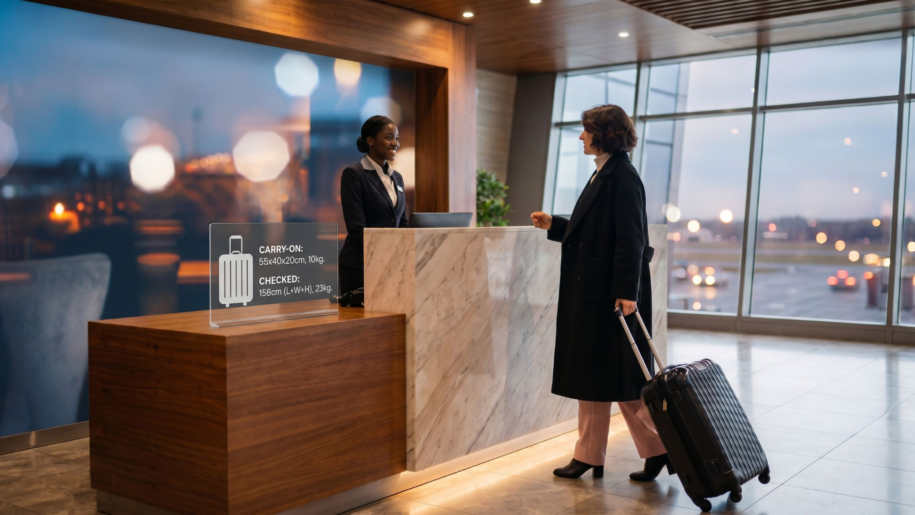
Luggage rules can feel deceptively simple until you are in the airport queue with a bag that is “just a bit” too heavy, a bottle that is “almost” 100 ml, or a carry-on that fits your car trunk but not the airline’s sizer. Understanding the basics—what you can bring, where you can pack it, and what might cost extra—helps you avoid delays, fees, and last-minute repacking at security.
This guide explains the main luggage restrictions for flights in a practical way: carry-on vs checked baggage, typical size and weight limits, common charges, and the rules around liquids and gels. Because airline and airport rules can vary by route, carrier, and even fare type, you’ll also find advice on how to double-check policies before departure and how to plan when traveling in Italy.
Table of contents
- Carry-on baggage restrictions
- Checked baggage allowances
- Common baggage charges
- Specific luggage restrictions in Italy
- Liquids and gels in baggage
- Frequently Asked Questions
Carry-on baggage restrictions
“Carry-on” (also called cabin baggage or hand luggage) includes the bag you bring on board and place in the overhead bin, plus a smaller personal item that fits under the seat (where permitted). Restrictions focus on two goals: keeping aisles and overhead bins safe and manageable, and meeting aviation security requirements. While many travelers think of carry-on rules only as “size,” the stricter issues are often weight and what is inside.
Airlines may publish different allowances depending on your fare (basic economy vs standard), frequent flyer status, and route (domestic vs international). Low-cost carriers in particular may include only a personal item in the base fare and charge for larger cabin bags. Even when the published allowance looks similar across airlines, enforcement can be different: some carriers regularly weigh cabin bags at the gate, others rarely do. Planning as if it will be checked is the safest approach.
Size and weight limits for carry-on luggage
There is no single worldwide standard for carry-on size, but most airlines set a maximum around the common “cabin roller” format. Typical limits fall roughly in the range of 50–56 cm for height and 20–25 cm for depth, with a total linear dimension (height + width + depth) often around 115 cm. Weight limits vary even more: some airlines allow 7–10 kg, while others publish higher or lower thresholds.
What matters operationally is whether your bag fits in the airline’s bag sizer (including wheels and handles) and whether you can lift it safely into the overhead bin. If you are close to the limit, pay attention to details that commonly cause issues:
- Hard-shell suitcases may have less “give” and can fail the sizer even if the dimensions on the label look compliant.
- Expandable zippers can turn a compliant bag into an oversized one once you pack it full.
- Personal items (backpack, laptop bag, tote) are often restricted too; “small” usually means it must fit fully under the seat in front of you.
If you travel to cities like Milan in different seasons, carry-on planning becomes even more important because bulky outerwear can push you over the limit. A practical way to reduce weight is to wear the heaviest items (coat, boots) and pack lighter layers. For packing logic that adapts to weather and activities, see smart packing tips for Milan across seasons.
Prohibited items in carry-on baggage
Security restrictions for carry-on baggage focus mainly on items that can be used as weapons or pose a safety risk. Most airports follow similar principles even if the exact list can differ. Common categories that are typically restricted in the cabin include:
- Sharp objects (many knives, box cutters, certain scissors), and tools that can be used to cut or puncture.
- Blunt instruments that could cause injury (some sporting equipment, certain tools).
- Flammable items and chemicals (some fuels, certain solvents), depending on type and quantity.
- Large liquid containers beyond the allowed limits (covered in the liquids section).
Two common points of confusion are batteries and medical items. In general, spare lithium batteries are often required to be carried in the cabin rather than checked, but they must be protected against short-circuiting (for example, in original packaging or with terminals covered). Meanwhile, medications are usually allowed in carry-on, and it is wise to keep essential prescriptions with you in case checked bags are delayed. Always confirm the latest requirements with your airline and the airport’s security guidance, especially if you travel with special equipment or larger quantities of liquids for medical reasons.
Checked baggage allowances
Checked baggage is luggage you hand over at the check-in counter (or bag drop) to be transported in the aircraft hold. Policies here are heavily influenced by aircraft loading constraints and baggage handling systems. Checked-bag allowances are typically defined by number of pieces, weight per piece, and maximum dimensions. Your ticket might include zero, one, or more checked bags depending on fare class and airline.
If you are combining air travel with multiple hotel stays, train trips, and day excursions, checked baggage can be convenient—but it also introduces the risk of waiting at baggage claim or dealing with delays. Many travelers use carry-on only to stay flexible, but that requires tighter compliance with cabin restrictions. Consider your itinerary style when deciding how much to check.
Weight and dimension limits for checked luggage
Many airlines use a standard weight limit per checked bag, commonly 23 kg for economy on full-service carriers and sometimes lower or higher depending on ticket type and destination. Some carriers—especially on certain routes—use a “piece concept” (a set number of bags with weight limits) while others use a “weight concept” (a total weight across all checked bags). Maximum dimensions are often expressed as a linear total (for example, height + width + depth), and oversized items may be accepted only with extra fees or special handling.
Practical tips to avoid problems at the counter:
- Weigh at home with a luggage scale. Even a 0.5–1 kg buffer helps.
- Measure with wheels and handles included. Those add up.
- Split heavy items across two bags if your fare includes multiple pieces; this is often cheaper than an overweight fee.
For travelers planning a city-based itinerary (museums, shopping, walking), it can help to pack with your activities in mind. If your trip includes long days exploring on foot, a lighter setup reduces stress before you even reach the airport. If Milan is on your route, you may find it useful to read how walkable Milan is and how to plan a comfortable day out—because the way you move through the city should influence how you pack.
Items not allowed in checked baggage
Checked baggage can take items that are restricted in the cabin (like larger liquid bottles), but it is not a “free zone.” Some items are prohibited in the aircraft hold due to fire risk, chemical hazards, or pressure changes. In addition, airlines and security authorities may restrict valuables in checked baggage because of theft and liability concerns.
Because the exact list can vary by country and airline, a reliable starting point is to check a dedicated FAQ list before you pack. Baggysitter maintains an overview of common questions and practical restrictions: see Baggysitter’s luggage and travel FAQs for reference and for links to the relevant policies you should verify with your carrier.
As general guidance, avoid putting the following into checked luggage unless you have explicit confirmation that it is allowed and safely packed:
- Spare lithium batteries and power banks (often restricted in checked baggage; many must be carried in the cabin).
- Flammables (certain fuels, paint thinners, some aerosols) and corrosive chemicals.
- High-value items (cash, jewelry, critical electronics). Even if permitted, it is safer to keep them with you.
Common baggage charges
Baggage fees are one of the most variable parts of airline pricing. Two passengers on the same flight can pay very different total amounts depending on when they add bags (online vs at the airport), what fare they bought, and whether a bag is overweight or oversized. When comparing flight options, the most accurate approach is to price the itinerary as you will actually travel: number of bags, estimated weight, and whether you need a cabin roller or only a personal item.
Fees for overweight and oversized luggage
Overweight and oversized fees exist because heavy or large bags require additional handling and can slow down baggage operations. Airlines usually apply overweight fees once a bag exceeds the standard weight allowance (for example, above 23 kg), and oversized fees when dimensions exceed the maximum. In some cases, both apply to the same bag.
To reduce the likelihood of paying these fees:
- Plan weight distribution: put dense items (shoes, toiletries, chargers) in different bags or in your personal item if permitted.
- Use lighter luggage: the suitcase itself can account for several kilograms.
- Consider shipping or alternative transport for specialized equipment when the airline’s sports/oversize policy is expensive.
If you are returning from a trip that includes shopping—fashion, gifts, or local foods—your return flight is where overweight problems often appear. If your itinerary includes Milan, it is worth planning ahead for purchases from areas like the fashion district; this can influence whether you should bring a foldable extra bag or leave space in your checked luggage. For context on where shopping tends to happen, see the Milan Fashion District guide.
Charges for additional baggage
“Additional baggage” charges usually apply when you exceed the number of bags included in your fare. This can mean:
- Adding a checked bag when none is included.
- Bringing a larger cabin bag when your ticket includes only a personal item.
- Checking a second or third bag beyond the standard allowance.
Most airlines price these services cheaper online in advance than at the airport, and some also cap the number of bags per passenger on certain routes. If you are traveling with family or as a group, it can be cheaper to redistribute items so you stay within each person’s allowance rather than paying for extra pieces. Also remember that some carriers have strict rules about combining allowances; for example, one passenger cannot always “use” another passenger’s unused bag entitlement.
Specific luggage restrictions in Italy
When flying in or within Italy, you will typically encounter the same overarching aviation security principles used across Europe, but the practical experience can differ by airport layout, staffing, and the mix of airlines operating. Italy also has a strong presence of both full-service and low-cost carriers, which means baggage policy differences are often driven more by airline commercial rules than by the country itself.
If your travel plan includes multiple Italian cities, remember that train travel is common and does not impose the same formal baggage “allowances” as airlines—but it still has practical limits (stairs, crowded platforms, smaller overhead racks). Thinking of your luggage as an end-to-end mobility choice—not just an airline requirement—usually leads to better decisions.
Local airline policies for baggage
Italy hosts a mix of carriers with different baggage models. Full-service airlines may include a cabin bag and sometimes checked baggage, depending on the fare. Low-cost airlines, on the other hand, often unbundle baggage and enforce size and weight limits more strictly.
The key point is that “European flight” does not automatically mean “European baggage standard.” Always check:
- What your fare includes (personal item only vs cabin bag vs checked bag).
- Cabin bag dimensions specific to that airline’s policy.
- Gate-check rules vary by airline: some carriers allow you to bring a cabin bag to the gate. They may charge a fee if it exceeds size limits or if overhead space is full.
If you’re building an itinerary around major cities, the way you move between neighborhoods can influence the type of luggage that is practical.
For travelers comparing destinations, it helps to understand different city rhythms, such as walking distances and public transport options.
If you are deciding between key hubs, it may also help to compare them.
For example, a guide to Milan vs Rome for visitors can give useful context, as it can affect how much you need to carry day to day.
Airport security guidelines in Italy
Security screening in Italian airports generally follows European rules for prohibited items and liquids. That said, the passenger experience can vary: some terminals have modern lanes with different procedures. For example, you may not need to remove laptops at certain checkpoints, while others follow more traditional steps.
To avoid friction:
- Arrive with liquids already separated in an easy-to-reach bag.
- Keep electronics accessible in case you must remove them.
- Be prepared for additional checks for items that look unusual on X-ray (dense foods, cables, souvenirs).
Finally, consider that airport rules are only part of the travel day. If you arrive early or have time between check-out and your flight, planning your activities without dragging luggage can make the day smoother—especially in museum-heavy cities. If Milan is in your plan and weather is uncertain, you might map a light itinerary using indoor activities and rainy-day ideas in Milan to avoid overpacking “just in case.”
Liquids and gels in baggage
Liquids rules are one of the most consistently enforced parts of aviation security, and they are also where travelers most often lose items. The main concept for carry-on is that liquids, aerosols, gels, creams, and pastes are restricted in container size and must be presented in a specific way at security. In checked baggage, these restrictions are generally looser, but safety rules still apply for flammables and pressurized containers.
Rules for toothpaste and other liquids
Toothpaste is typically treated as a gel/paste under security rules, meaning it counts toward your liquid allowance in carry-on baggage. The same applies to items like hair gel, liquid foundation, some creams, and similar toiletries. If you are unsure whether something is considered a liquid, the safest assumption is that it will be treated as one if it can be spread, poured, sprayed, or squeezed.
Two practical strategies help avoid confiscation:
- Choose travel-size containers for carry-on and keep full-size products in checked baggage (when permitted).
- If you need a particular product on arrival, pack a compliant amount in carry-on and the remainder in checked baggage.
Packaging and quantity limits
On most flights departing from airports applying standard international security rules, carry-on liquids must be in containers of limited capacity (commonly 100 ml each) and placed together in a single, transparent, resealable bag with a limited total capacity (commonly around 1 liter). You are usually asked to remove this bag at screening. Even if a bottle is half empty, it may be refused if the container’s stated capacity exceeds the limit.
For checked baggage, you can typically pack larger toiletries, but it’s wise to prevent leaks: place liquids in sealed pouches, use tape over caps, and pack them away from clothing. Pressure and handling can cause small openings to spill. Aerosols and sprays can be more sensitive; always check airline rules for what is permitted in the hold.
Frequently Asked Questions
What is not allowed in your checked baggage?
Checked baggage cannot include certain hazardous materials (especially items that present a fire risk, such as some battery types or flammable substances) and may be restricted for specific chemicals, aerosols, or pressurized containers. Policies can differ based on airline and route, so the most practical approach is to confirm using a reliable reference and then verify with your carrier. For an overview and common examples, consult Baggysitter’s frequently asked questions about luggage and travel and follow the links to the relevant authority or airline guidance.
What are the baggage restrictions for a typical flight?
A typical flight has two main sets of restrictions: cabin baggage (size/weight limits plus prohibited items and liquids rules) and checked baggage (piece/weight/dimension allowances plus restrictions for hazardous items). The “typical” allowance depends heavily on the airline’s business model and the fare you purchased. When in doubt, read your booking confirmation carefully, then check the airline’s baggage page for your specific route and fare. If you want a structured checklist of what to verify, the FAQ section is a useful starting point.
What are the size limits for carry-on luggage
Carry-on size limits vary by airline; many fall near the common cabin suitcase range (often around 55 cm height), but you should treat that as a reference rather than a guarantee. Always include wheels and handles in measurements and consider that enforcement may occur at the gate using a rigid sizer. If you are traveling with a personal item in addition to a cabin bag, check that both items meet the specified dimensions.
Are there extra charges for baggage on international flights?
There can be. Some international routes include checked baggage in standard economy fares, while others—especially on low-cost or “light” fare bundles—do not. Fees can also rise on international itineraries when you add bags late (at the airport), when you check additional pieces, or when a bag is overweight or oversized.
Codeshare flights can add complexity: baggage rules may follow the “most significant carrier” on the itinerary, so it’s important to confirm which airline’s policy applies end to end.
Is toothpaste considered a liquid for carry-on restrictions?
In most airport security frameworks, toothpaste is treated as a gel/paste and therefore counts as a liquid-type item for carry-on screening. Pack it in a compliant container (commonly up to 100 ml) and include it in your transparent resealable liquids bag. If you prefer to bring a full-size tube, place it in checked baggage if permitted and pack it to prevent leaks.
Finally, remember that baggage restrictions are not only about compliance—they are a planning tool. When you understand what you can carry on, what you can check, and what may cost extra, it becomes easier to build a smoother travel day, especially on multi-stop itineraries.
If your trip includes time in Milan and you want to design days that don’t depend on hauling bags everywhere, it can help to plan experiences—food, neighborhoods, and timing—in advance; for inspiration, see typical Milanese dishes and where to eat and build your schedule around what matters most.
One Comment
Left luggage Milan: secure, affordable storage landmarks
[…] about bringing a larger bag, consider airline rules and city storage together. Read our guides on luggage restrictions and fees and packing a suitcase efficiently. Both help you avoid last-minute costs, in the air and on the […]